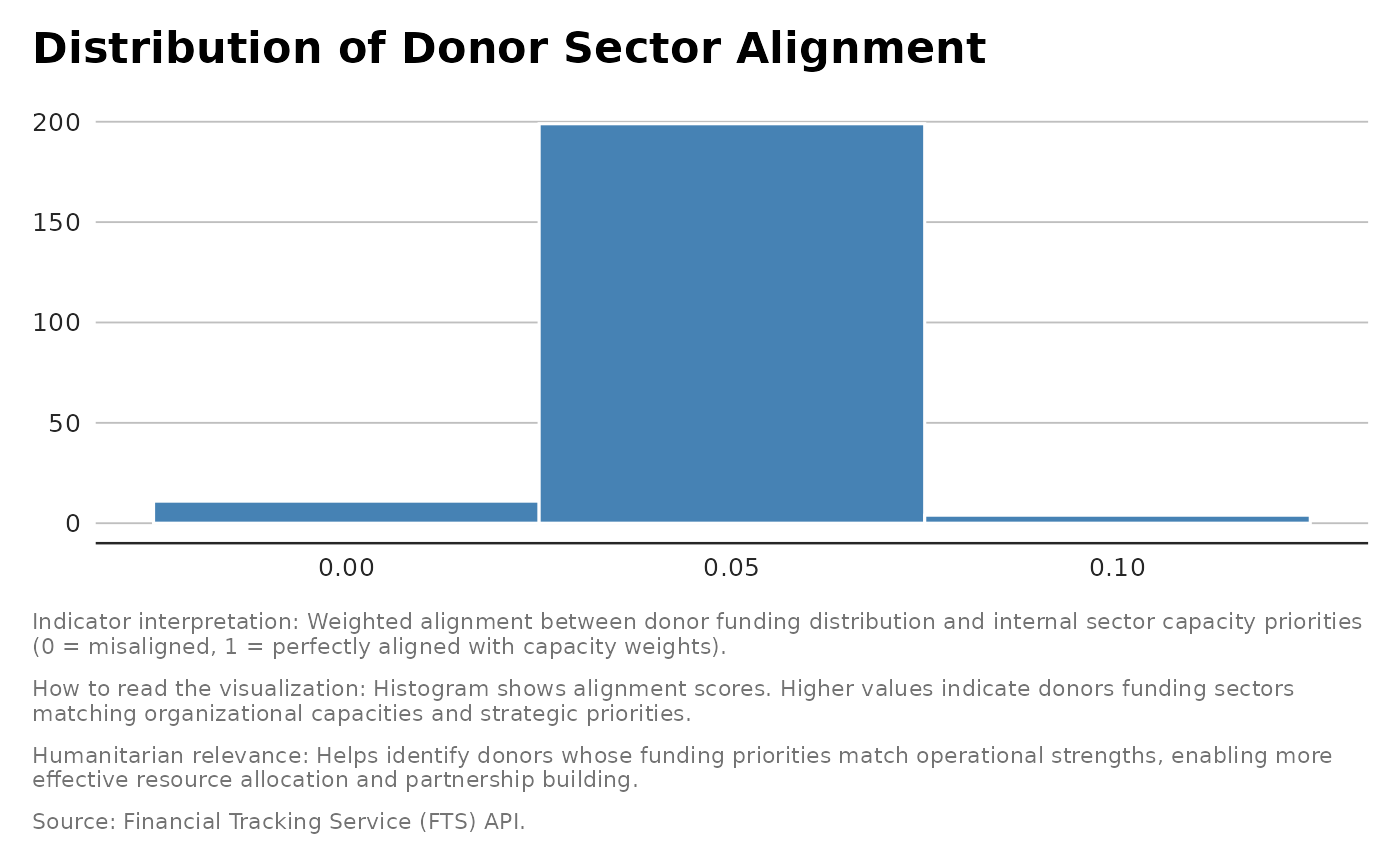
Calculates a weighted sector alignment index between donors and recipients, comparing donor funding per sector to internal capacity weights.
Details
Goal: evaluates how closely a donor’s funding distribution across humanitarian sectors matches the internal capacity or priority weighting of those sectors
Examples
flows |>
      tidyr::unnest(destinationObjects, names_repair = "unique", names_sep = "_") |>
      dplyr::filter(destinationObjects_type == "GlobalCluster") |>
      dplyr::pull(destinationObjects_name) |>
      unlist() |>
      unique()
#>  [1] "Nutrition"
#>  [2] "Health"
#>  [3] "Other"
#>  [4] "Emergency Shelter and NFI"
#>  [5] "Water Sanitation Hygiene"
#>  [6] "Food Security"
#>  [7] "Logistics"
#>  [8] "Coordination and support services"
#>  [9] "Protection - Gender-Based Violence"
#> [10] "Multi-sector"
#> [11] "Protection"
#> [12] "Education"
#> [13] "Early Recovery"
#> [14] "Protection - Child Protection"
#> [15] "Protection - Mine Action"
#> [16] "Agriculture"
#> [17] "Protection - Housing, Land and Property"
#> [18] "Camp Coordination / Management"
#> [19] "Protection - Human Trafficking & Smuggling"
#> [20] "Multipurpose Cash"
#> [21] "Emergency Telecommunications"

# pragmatic default weights - illustrative defaults emphasizing life-saving sectors
# (Nutrition, Health, WASH, Food Security) and cash/multi-sector where relevant.
library(tibble)

sectors <- c(
 "Nutrition",
 "Health",
 "Emergency Shelter and NFI",
 "Water Sanitation Hygiene",
 "Food Security",
 "Logistics",
 "Protection - Gender-Based Violence",
 "Protection - Child Protection",
 "Protection",
 "Multipurpose Cash",
 "Education",
 "Multi-sector",
 "Protection - Housing, Land and Property",
 "Protection - Human Trafficking & Smuggling",
 "Coordination and support services",
 "Camp Coordination / Management",
 "Emergency Telecommunications",
 "Agriculture",
 "Early Recovery",
 "Protection - Mine Action",
 "Other"
)

# Adjusted scores based on funding collapse and operational risk

adjusted_scores <- c(
  10,  # Nutrition: Life-saving and first-line response; malnutrition spikes in
  #crises. Funding collapse means ration cuts, so priority remains highest.
  9,   # Health: Essential for survival; clinics reverting to 1990s models
  #(minimal staff, basic meds). High priority to prevent mortality.
  8,   # Emergency Shelter and NFI: Critical for displaced populations;
  #exposure risk rises with underfunding. Still high but slightly below health/nutrition.
  8,   # Water Sanitation Hygiene (WASH): Prevents disease outbreaks;
  #cholera risk escalates when systems fail. Needs strong prioritization.
  7,   # Food Security: Linked to nutrition but broader (agriculture, livelihoods).
  #Funding gaps mean rationing; still vital but slightly less than direct nutrition.
  6,   # Logistics: Backbone for all sectors; underfunding reduces supply chain
  #resilience. Important but not life-saving on its own.
  7,   # Protection - Gender-Based Violence: GBV spikes in fragile contexts;
  #services often first to be cut. Needs strong prioritization for dignity and safety.
  6,   # Protection - Child Protection: Critical for safeguarding vulnerable
  #children; funding collapse risks exploitation. Medium-high priority.
  5,   # Protection (general): Important for rights and safety but less
  #immediately life-saving than GBV or child protection.
  9,   # Multipurpose Cash: Severely underfunded (only ~20% coverage);
  #key for dignity and flexibility. High priority to maintain household resilience.
  8,   # Education: Collapsing (21% funded); long-term impact on recovery
  #and protection. Elevated priority despite being non-life-saving.
  6,   # Multi-sector: Coordination across sectors matters, but direct impact
  # is less urgent than core life-saving interventions.
  4,   # Protection - Housing, Land and Property: Important for durable
  #solutions, but less urgent during acute collapse.
  4,   # Protection - Human Trafficking & Smuggling: Serious risk but narrower
  #scope; medium-low priority compared to GBV/child protection.
  3,   # Coordination and support services: Necessary for system functioning,
  # but deprioritized when survival sectors collapse.
  3,   # Camp Coordination / Management: Important for organized response,
  #but less critical than food, health, WASH.
  3,   # Emergency Telecommunications: Enables operations but not directly
  #life-saving; deprioritized under severe funding constraints.
  5,   # Agriculture: Supports food security and recovery; medium priority
  #as immediate needs dominate.
  8,   # Early Recovery: Only 17% funded; crucial for resilience and
  #preventing protracted crises. Elevated priority despite systemic collapse.
  2,   # Protection - Mine Action: Important for safety but less urgent
  # than health/nutrition during acute funding collapse.
  1    # Other: Catch-all category; lowest priority given resource scarcity.
)


sector_capacity <- tibble::tibble(
  sector = sectors,
  raw_score = adjusted_scores) |>
  dplyr::mutate(
    capacity_weight = raw_score / sum(raw_score)  # normalize to sum to 1
  ) |>
  dplyr::select(sector, capacity_weight)

knitr::kable(sector_capacity |> dplyr::arrange(desc(capacity_weight)))
#>
#>
#> |sector                                     | capacity_weight|
#> |:------------------------------------------|---------------:|
#> |Nutrition                                  |       0.0819672|
#> |Health                                     |       0.0737705|
#> |Multipurpose Cash                          |       0.0737705|
#> |Emergency Shelter and NFI                  |       0.0655738|
#> |Water Sanitation Hygiene                   |       0.0655738|
#> |Education                                  |       0.0655738|
#> |Early Recovery                             |       0.0655738|
#> |Food Security                              |       0.0573770|
#> |Protection - Gender-Based Violence         |       0.0573770|
#> |Logistics                                  |       0.0491803|
#> |Protection - Child Protection              |       0.0491803|
#> |Multi-sector                               |       0.0491803|
#> |Protection                                 |       0.0409836|
#> |Agriculture                                |       0.0409836|
#> |Protection - Housing, Land and Property    |       0.0327869|
#> |Protection - Human Trafficking & Smuggling |       0.0327869|
#> |Coordination and support services          |       0.0245902|
#> |Camp Coordination / Management             |       0.0245902|
#> |Emergency Telecommunications               |       0.0245902|
#> |Protection - Mine Action                   |       0.0163934|
#> |Other                                      |       0.0081967|

result <- indicator_donor_sector_alignment(flows, sector_capacity)
print(result$plot)